Tuesday, March 29, 2011
Skype Interview
While a short interview, I enjoyed it. If you ever get a chance to speak with her, I highly suggest it.

Sunday, March 27, 2011
Blog Post #9

What I've Learned This Year
I think this post is absolutely amazing. I'm glad to see that Mr. McClung learned these things and within his first year of teaching too.
While I understand that everyone in the world hopes to have everything perfect, it's really not going to happen. It's impossible. And the sooner you realize that, the better off you are. You won't stress yourself more than you need to. Besides, going with he flow of things is not only easier, but it tends to be a little more interesting and not quite so boring.
I also think that teachers need to really listen to their students. I've had so many classes where teachers don't want to hear what you have to say. They don't want to listen to anything unless you're answering a question or asking one, sometimes not even then. Too many of them don't allow students to challenge them (respectfully) and explore with their words. Sometimes this can make a teacher scary and unapproachable.
As for communicating, do it! Communicate in personal relationships like marriages and friendships, but also communicate in professional relationships. There are going to be times when you're going to need help and who better to help you than your co-workers?
I think a lot of the points Mr. McClung made are common sense, or ought to be anyway.
Comments for Kids 4, 5, and 6

The first blog I commented on belonged to a student named Unaloto. His most recent blog post discussed the movie Megamind and the movie Despicable Me. Unaloto was asking for opinions on which one people thought was better and he used great pictures in the post.
The second student, a boy named Junior, wrote a blog post on how he wanted to become a doctor. I think it's wonderful that he knows what he wants to do already. I personally changed my mind at least a hundred times by the time I got into college.
The third student, Shawnee, wrote a post about how to get rid of hiccups and even included a link to a video on the subject. I thought her post was very helpful, since I hate hiccups; they tend to hurt when I get them.
C4T #3
The Power of Educational Technology
For this C4T assignment, I was told to look over Liz B. Davis' blog. Well, the first post I came across was a short one talking briefly about Edcamp Boston. Well, I got curious and Googled Edcamp Boston. What I found out was that Edcamp Boston is an unconference to addresses issues in education and throw around ideas on how to fix them or to just give ideas in general. So, what's an unconference? I had to Google that too. An unconference is a gathering that tries to avoid certain aspects of the normal conference, like high fees, and is participant-driven. It seems Edcamp Boston has succeeded in being a successful unconference. It's free to attend and it's sponsors offer free breakfast and coffee and free lunch, along with free entry. However, what marks it as even more successful is the fact that the limited number of spots filled up within about a week. I think perhaps teachers should attend one of these education unconferences; it's always good to get other opinions.
The second post I read through and commented on talked about how Belmont Hill School faculty have made amazing progress, but Davis wondered if she should push them even further before the school year lets out. However, she was curious as to whether this was the right choice or not, and frankly, I don't think so. I understand her enthusiasm and her want for the school to improve further when it comes to using technology, but changing everything all at once isn't necessarily the best choice. Sometimes it's better to introduce things slowly and allow people to get accustomed to the changes. But I do have to say that it is great that she is so enthusiastic about making more changes.
Sunday, March 13, 2011
Blog Post #8
This Is How We Dream
I believe I'm prepared to write with multimedia and I do intend on teaching my students how to do the same. Though I may sound a little redundant, it's important that today's and tomorrow's students are prepared for the future. And that future includes technology.
I think it's amazing that all the information we could possibly need for anything can be found on the internet and can also be gathered from sources using video conferencing. These two things have made it possible for people to gather all of their information without having to meet with people face-to-face, which is growing increasingly harder as work-loads grow. Not to mention they allow people to access everything from home. The age of using giant, old, and dusty books for research seems to be coming to an end. At least, very slowly.
I think things like novels and comic books may be around a lot longer, but they too may be going out of style, since things like the Kindle have been created. But my point is, I need to be able to keep up with things like this and I need to be able to use them effectively in order to teach my students how to use them. And I certainly plan on keeping up with technology.

The Chipper Series and EDM 310 for Dummies
The Chipper Series was a great video. It really drives home the importance of striving for excellence and not taking shortcuts. As for the EDM 310 for Dummies video, that one was great too. It was very creative and entertaining.
I would personally love to make a video that is English/ Language Arts related. I think it would be on the importance of reading, or the importance of using proper English. Those are two things I think are the biggest issues when it comes to teaching students English/ Language Arts.
Learn to Change, Change to Learn
I agree with the arguments made in this video. People are swept up in exploring the world through cell phones, iPods, iPads, laptops, etc. However, many schools have BANNED these things so students are forced to force themselves to learn by reading their notes and textbooks. The old fashioned way isn't always effective because 1) it's boring and 2) some students learn better through doing or seeing, not reading. Which means, the technologies and the "nuisances" ought to be incorporated into classrooms and lesson plans. Yes, teachers will still struggle with those students who use the devices to play games while in class, but overall it would be beneficial.
The Secret Powers of Time by Philip
Zambardo
This video basically breaks down people and time. It says that there are three different types of people, future oriented, past oriented, and present oriented. Future oriented people are those that "work harder" than others. They aren't stuck on what happened in the past.
I think this particular message pertains to education in that past oriented people are too busy with what happened to pay enough attention to what they -should- be working for, like an education and a better future. And the present oriented people are too consumed with what's happening now to pay attention to what they should be working for too. So, being future oriented would be the better choice. They are the people who work for what they think should happen; they work for the better education and better future.
Drive: The Surprising Truth About What Motivates Us by David Pink
This video discusses what motivates people and I found it odd that the more money that's offered as a reward for a complicated task, the poorer the job is done. However, it makes sense. Yes, people like being rewarded for what they do, but people like independence even more and it all ties in perfectly with education. Students do tend to prefer to teach themselves things and just ask for help if and when they need it. There have been plenty of literature classes where my teachers has had the class read things out loud or the teacher does it and I'm silently screaming "Stop!! I want to do the work and the reading on my OWN!" Drove me insane since I usually worked a good deal faster than everyone else. Rewards only go so far, but allow people to work independently and you'll be surprised at what they can accomplish and learn.
I believe I'm prepared to write with multimedia and I do intend on teaching my students how to do the same. Though I may sound a little redundant, it's important that today's and tomorrow's students are prepared for the future. And that future includes technology.
I think it's amazing that all the information we could possibly need for anything can be found on the internet and can also be gathered from sources using video conferencing. These two things have made it possible for people to gather all of their information without having to meet with people face-to-face, which is growing increasingly harder as work-loads grow. Not to mention they allow people to access everything from home. The age of using giant, old, and dusty books for research seems to be coming to an end. At least, very slowly.
I think things like novels and comic books may be around a lot longer, but they too may be going out of style, since things like the Kindle have been created. But my point is, I need to be able to keep up with things like this and I need to be able to use them effectively in order to teach my students how to use them. And I certainly plan on keeping up with technology.
The Chipper Series and EDM 310 for Dummies
The Chipper Series was a great video. It really drives home the importance of striving for excellence and not taking shortcuts. As for the EDM 310 for Dummies video, that one was great too. It was very creative and entertaining.
I would personally love to make a video that is English/ Language Arts related. I think it would be on the importance of reading, or the importance of using proper English. Those are two things I think are the biggest issues when it comes to teaching students English/ Language Arts.
Learn to Change, Change to Learn
I agree with the arguments made in this video. People are swept up in exploring the world through cell phones, iPods, iPads, laptops, etc. However, many schools have BANNED these things so students are forced to force themselves to learn by reading their notes and textbooks. The old fashioned way isn't always effective because 1) it's boring and 2) some students learn better through doing or seeing, not reading. Which means, the technologies and the "nuisances" ought to be incorporated into classrooms and lesson plans. Yes, teachers will still struggle with those students who use the devices to play games while in class, but overall it would be beneficial.
The Secret Powers of Time by Philip
Zambardo
This video basically breaks down people and time. It says that there are three different types of people, future oriented, past oriented, and present oriented. Future oriented people are those that "work harder" than others. They aren't stuck on what happened in the past.
I think this particular message pertains to education in that past oriented people are too busy with what happened to pay enough attention to what they -should- be working for, like an education and a better future. And the present oriented people are too consumed with what's happening now to pay attention to what they should be working for too. So, being future oriented would be the better choice. They are the people who work for what they think should happen; they work for the better education and better future.
Drive: The Surprising Truth About What Motivates Us by David Pink
This video discusses what motivates people and I found it odd that the more money that's offered as a reward for a complicated task, the poorer the job is done. However, it makes sense. Yes, people like being rewarded for what they do, but people like independence even more and it all ties in perfectly with education. Students do tend to prefer to teach themselves things and just ask for help if and when they need it. There have been plenty of literature classes where my teachers has had the class read things out loud or the teacher does it and I'm silently screaming "Stop!! I want to do the work and the reading on my OWN!" Drove me insane since I usually worked a good deal faster than everyone else. Rewards only go so far, but allow people to work independently and you'll be surprised at what they can accomplish and learn.
Thursday, March 10, 2011
Friday, March 4, 2011
PLN Progress Report
At first it was a little difficult figuring out what I ought to include in my PLN. However, as I got to thinking, I realized it wasn't that hard. So, the point of EDM 310 is to prepare future teachers for using technology in their classrooms and the point of being in college period is to prepare for being (in our cases) teachers. So, why not create a PLN that has to do with my future job? It might not be useful to the fullest extent, but it does allow me to research things and start at least thinking about my future lesson plans. Not to mention it can help me create connections with other teachers who can in turn help me. One great thing I found to help me connect with other teachers was a list of teachers who use Twitter. It gives their name, their subject, the grade the teach, where they are located, and their Twitter name. Definitely going to make use of this list.
Monday, February 28, 2011
Blog Post 7
The Last Lecture

When I saw that we were required to watch this lecture and write a blog post on it, I got extremely excited. I've seen bits and pieces of this lecture and even bought the book, which I never got completely through (gotta love school and work taking over your life). I've been meaning and wanting to sit down and watch this video, but had trouble finding the time; this assignment gave me the perfect opportunity. And I'm glad.
Randy Pausch is an inspirational man and his lecture proves it. Near the beginning of his lecture he says "We cannot change the cards we are dealt, just how we play the hand" and it's true. As a teacher you aren't able to pick and choose your students and how they act. You can't and won't have a class full of geniuses and students who actually want to learn. It's not possible. However, you can take what you get and work with it. You can take the students who have trouble with certain materials and help them learn it. You can take the students who despise school and who would rather be out back smoking a cigarette and help them realize learning is important and CAN be fun. As a teacher, you have to take a group of students, the cards you're dealt, and mold them into capable members of society who can think on their own and teach themselves and teach others.
Pausch also said "You have to get the fundamentals down, or the fancy stuff won't work." Isn't this how learning works? In math, for example, you start with learning numbers, then move to simple addition, then to simple subtraction, simple multiplication, simple division, then on to more complicated things like using the FOIL method and the quadratic equation and so on. And it's the teachers' job to ensure that students get these fundamentals and commit them not only to short term spit-it-out-on-a-test memory, but to long term I-understand-the-concept memory. Like I stated in the previous blog post, teachers need to change their teaching methods and need to teach their students not a set of instructions, but a set of ideas, methods, concepts that they can use throughout their life (and therefore will always remember).
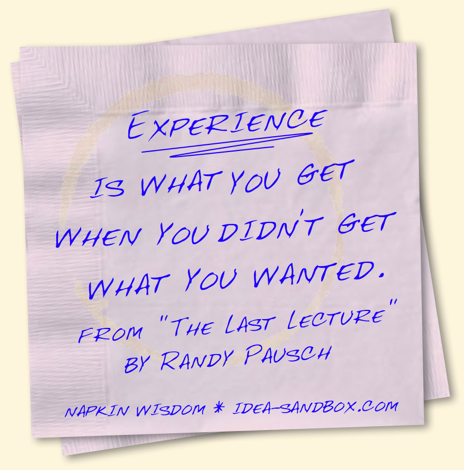
Now, as a current student studying to become a teacher, I know there are going to be times while I'm new to the field that I'm going to become frustrated and dejected and feel that I'm not doing things right; that I'm not doing everything in my power to teach my students the material and lessons they will keep with them forever. After watching this video, though, I now have one simple sentence to keep me going and keep my spirits up: "Experience is what you get when you didn't get what you wanted." I'm not always going to get through to students and help them see the importance of literature and good grammar, but I have to remember that I can learn from the experience and use what I learn on the next group of students I'm fortunate enough to have in my classroom. By my standards, I'm not always going to succeed, but that doesn't mean I failed either and I have to remember that, as does every other teacher.
When I saw that we were required to watch this lecture and write a blog post on it, I got extremely excited. I've seen bits and pieces of this lecture and even bought the book, which I never got completely through (gotta love school and work taking over your life). I've been meaning and wanting to sit down and watch this video, but had trouble finding the time; this assignment gave me the perfect opportunity. And I'm glad.
Randy Pausch is an inspirational man and his lecture proves it. Near the beginning of his lecture he says "We cannot change the cards we are dealt, just how we play the hand" and it's true. As a teacher you aren't able to pick and choose your students and how they act. You can't and won't have a class full of geniuses and students who actually want to learn. It's not possible. However, you can take what you get and work with it. You can take the students who have trouble with certain materials and help them learn it. You can take the students who despise school and who would rather be out back smoking a cigarette and help them realize learning is important and CAN be fun. As a teacher, you have to take a group of students, the cards you're dealt, and mold them into capable members of society who can think on their own and teach themselves and teach others.
Pausch also said "You have to get the fundamentals down, or the fancy stuff won't work." Isn't this how learning works? In math, for example, you start with learning numbers, then move to simple addition, then to simple subtraction, simple multiplication, simple division, then on to more complicated things like using the FOIL method and the quadratic equation and so on. And it's the teachers' job to ensure that students get these fundamentals and commit them not only to short term spit-it-out-on-a-test memory, but to long term I-understand-the-concept memory. Like I stated in the previous blog post, teachers need to change their teaching methods and need to teach their students not a set of instructions, but a set of ideas, methods, concepts that they can use throughout their life (and therefore will always remember).
Now, as a current student studying to become a teacher, I know there are going to be times while I'm new to the field that I'm going to become frustrated and dejected and feel that I'm not doing things right; that I'm not doing everything in my power to teach my students the material and lessons they will keep with them forever. After watching this video, though, I now have one simple sentence to keep me going and keep my spirits up: "Experience is what you get when you didn't get what you wanted." I'm not always going to get through to students and help them see the importance of literature and good grammar, but I have to remember that I can learn from the experience and use what I learn on the next group of students I'm fortunate enough to have in my classroom. By my standards, I'm not always going to succeed, but that doesn't mean I failed either and I have to remember that, as does every other teacher.
C4T #2
What Ed Said
The first post I encountered spoke of a conversation Mrs. Edna Sackson had with a teacher. According to the post, the teacher preferred to have all of her students doing the same thing at the same time. Mrs. Sackson saw the fault in this and thought to convince the teacher otherwise. She pointed out that the teacher had commented that her children are completely different. One is artistic and gets distracted easily, while the other learns quickly and is a thinker. So, doesn't that mean they learn in different ways? Yes, and Mrs. Sackson managed to get the teacher to realize this. Then, the teacher realized if it's true for her own children, then obviously it's true for all other children. Needless to say, the teacher made haste in changing her teaching plans.
Change isn't easy...
The second post I read by Mrs. Sackson was inspirational, to say the least. The whole post was full of great points, but the one that really stood out to me was that many teachers are stuck in their old way of teaching and either find it hard to change it or refuse to. As technology advances and more and more "cool" things are created, the less interesting an old book and chalkboard are going to have trouble keeping students' attention. So instead of fighting with students and yelling at them to pay attention, give them a reason to do so. Make it interesting.
Aside from that, the blog post made me think about the general method many teachers use to "teach" their students and mainly that it needs to change. Too many teachers simply shove information in their students' brains and think they did an excellent job if the students remember it long enough to take the test and do well. I was subjected to this method my whole middle school and high school career. Except for one teacher. My Algebra III with Statistics teacher was more concerned with his students actually learning and understanding the CONCEPTS of math and not simply memorizing steps on how to solve a certain type of problem. And at first it was frustrating and mind boggling that a teacher would even consider using a method like this. All I wanted to do was memorize steps and formulas to spit back on the tests.
I still don't have many teachers like my Algebra teacher, but I've had a few. I'm not balking anymore at the idea of learning and understanding concepts and ideas or even teaching myself. It's still slightly difficult for me to adjust to when I do have one of those teachers, though. Anyway, my point is that students shouldn't be in my situation; they shouldn't be having issues adjusting to these two methods at the same time. In fact, they shouldn't be adjusting to methods at all! Every teacher needs to be like my Algebra teacher.
The first post I encountered spoke of a conversation Mrs. Edna Sackson had with a teacher. According to the post, the teacher preferred to have all of her students doing the same thing at the same time. Mrs. Sackson saw the fault in this and thought to convince the teacher otherwise. She pointed out that the teacher had commented that her children are completely different. One is artistic and gets distracted easily, while the other learns quickly and is a thinker. So, doesn't that mean they learn in different ways? Yes, and Mrs. Sackson managed to get the teacher to realize this. Then, the teacher realized if it's true for her own children, then obviously it's true for all other children. Needless to say, the teacher made haste in changing her teaching plans.
Change isn't easy...
The second post I read by Mrs. Sackson was inspirational, to say the least. The whole post was full of great points, but the one that really stood out to me was that many teachers are stuck in their old way of teaching and either find it hard to change it or refuse to. As technology advances and more and more "cool" things are created, the less interesting an old book and chalkboard are going to have trouble keeping students' attention. So instead of fighting with students and yelling at them to pay attention, give them a reason to do so. Make it interesting.
Aside from that, the blog post made me think about the general method many teachers use to "teach" their students and mainly that it needs to change. Too many teachers simply shove information in their students' brains and think they did an excellent job if the students remember it long enough to take the test and do well. I was subjected to this method my whole middle school and high school career. Except for one teacher. My Algebra III with Statistics teacher was more concerned with his students actually learning and understanding the CONCEPTS of math and not simply memorizing steps on how to solve a certain type of problem. And at first it was frustrating and mind boggling that a teacher would even consider using a method like this. All I wanted to do was memorize steps and formulas to spit back on the tests.
I still don't have many teachers like my Algebra teacher, but I've had a few. I'm not balking anymore at the idea of learning and understanding concepts and ideas or even teaching myself. It's still slightly difficult for me to adjust to when I do have one of those teachers, though. Anyway, my point is that students shouldn't be in my situation; they shouldn't be having issues adjusting to these two methods at the same time. In fact, they shouldn't be adjusting to methods at all! Every teacher needs to be like my Algebra teacher.
Sunday, February 27, 2011
Saturday, February 26, 2011
Comments for Kids 1, 2, and 3.
Geometry

The first C4K post I was instructed to comment on was a post by Skylah about Geometry. In this post, Skylah expressed enthusiasm about Geometry and even included some great facts. I personally dislike math of any type, mainly because I'm horrible at it, but I enjoyed reading this post. It was interesting to read about Euclid and his contributions to Geometry.
KPE Episode 333: "Trapped"
The second post I was instructed to comment on was a podcast book report on the book "Trapped". Lola and Dante, the two students who created the podcast, did a wonderful job. Though the book is for a lower reading level, these two still managed to convince me to read it! It was great to see young students making use of something like a podcast.
Timoteo @ Pt England School
The third blog I had to comment on belongs to Timoteo form the Pt England School in Auckland, NZ. Timoteo only has a picture of himself up right now. However, I think it's great that he's being taught to use a blog and how to use technology. I'm 19 years old and this is the first time I've ever even seen the publishing/editing side of a blog. I think Timoteo's teacher is on the right track in teaching his students about technology and blogs.

The first C4K post I was instructed to comment on was a post by Skylah about Geometry. In this post, Skylah expressed enthusiasm about Geometry and even included some great facts. I personally dislike math of any type, mainly because I'm horrible at it, but I enjoyed reading this post. It was interesting to read about Euclid and his contributions to Geometry.
KPE Episode 333: "Trapped"
The second post I was instructed to comment on was a podcast book report on the book "Trapped". Lola and Dante, the two students who created the podcast, did a wonderful job. Though the book is for a lower reading level, these two still managed to convince me to read it! It was great to see young students making use of something like a podcast.
Timoteo @ Pt England School
The third blog I had to comment on belongs to Timoteo form the Pt England School in Auckland, NZ. Timoteo only has a picture of himself up right now. However, I think it's great that he's being taught to use a blog and how to use technology. I'm 19 years old and this is the first time I've ever even seen the publishing/editing side of a blog. I think Timoteo's teacher is on the right track in teaching his students about technology and blogs.
Blog Post #6
Wendy Drexler: The Networked Student
This video is great. It's simple, but highly entertaining and thought provoking. Many teachers and soon-to-be teachers are finding themselves a little fearful of becoming obsolete. Why? Well, because of things like the tons of apps and websites like SparkNotes that allow students to learn on their own.
However, students needed teachers way back when, they need teachers now, and they'll need teachers in the future. Think about it. Have you ever been in class and your teacher gives you an assignment that is very broad and you have no clue where to begin? What did you do? You probably looked around at your friends and asked if they had any clue what to do and when they shrugged at you, you went to the teacher. Anyway, my point is, is that you have to start somewhere when you begin on the road to becoming a networked student, but the question is "where do you start" and even "how do you start".
That's where the teachers come in. Teachers are there to help students learn about networking and set up the ties they need. Granted, there are plenty of websites and how-to videos floating around that students can access to help themselves, but even those can be confusing. Teachers are still going to be useful, regardless. It's just a matter of whether we make use of them or not.
A 7th Grader's Personal Learning Environment (or PLN)
This video was great. It was a perfect representation of all the things students can use a PLN/PLE for. This is a great way to teach students more responsibility, since lesson plans can be posted online for them to view and for them to complete. It also allows students to use their brains to gather needed information, instead of it being spoon-fed to them.
Why Smartboards Are A Dumb Initiative and Why I Hate Interactive Whiteboards
When I saw the titles to these two blog posts, I was thinking that the authors might be slightly nuts. Now that I've read the posts, I'm thinking maybe I was the one that was nuts; I was under its spell. You know, the "oooh look it's a pretty, new board that doesn't use markers or keyboards" spell. Well, these two authors sure weren't fooled.
One point is that it's not any more student friendly than normal white boards, and it's true. They're sparkly and dazzling in that they require no keyboard nor uses markers/chalk, but that's about it. It's nothing but a more expensive, more frustrating white board. Not to mention, only the teachers are given clearance to use them, more often than not. Which means, all the teacher is doing is presenting the same old information, only on a prettier board. Same tricks, new dog.
Using Electronic Whiteboards in Your Classroom: Benefits
So, this isn't exactly a blog post that opposes the two above, but it clearly is for the use of SMARTboards. It offers a list of why these interactive white boards are useful. Such as, "The board can accommodate different learning styles...". Well, yes and no. Yes, in that you can incorporate animation and music a little easier. No, in that some people are hands on learners and if teachers are the only ones who have permission to use them, then the hands on learners are kind of left out. The site also provides outside sources, like studies that were conducted. And according to those, SMARTboards are beneficial.
So, are the boards good or bad? Are they worth all that money or not? I suppose it's a matter of how you use them. It's also a matter of how interesting the lesson is.
This video is great. It's simple, but highly entertaining and thought provoking. Many teachers and soon-to-be teachers are finding themselves a little fearful of becoming obsolete. Why? Well, because of things like the tons of apps and websites like SparkNotes that allow students to learn on their own.
However, students needed teachers way back when, they need teachers now, and they'll need teachers in the future. Think about it. Have you ever been in class and your teacher gives you an assignment that is very broad and you have no clue where to begin? What did you do? You probably looked around at your friends and asked if they had any clue what to do and when they shrugged at you, you went to the teacher. Anyway, my point is, is that you have to start somewhere when you begin on the road to becoming a networked student, but the question is "where do you start" and even "how do you start".
That's where the teachers come in. Teachers are there to help students learn about networking and set up the ties they need. Granted, there are plenty of websites and how-to videos floating around that students can access to help themselves, but even those can be confusing. Teachers are still going to be useful, regardless. It's just a matter of whether we make use of them or not.
A 7th Grader's Personal Learning Environment (or PLN)
This video was great. It was a perfect representation of all the things students can use a PLN/PLE for. This is a great way to teach students more responsibility, since lesson plans can be posted online for them to view and for them to complete. It also allows students to use their brains to gather needed information, instead of it being spoon-fed to them.
Why Smartboards Are A Dumb Initiative and Why I Hate Interactive Whiteboards
When I saw the titles to these two blog posts, I was thinking that the authors might be slightly nuts. Now that I've read the posts, I'm thinking maybe I was the one that was nuts; I was under its spell. You know, the "oooh look it's a pretty, new board that doesn't use markers or keyboards" spell. Well, these two authors sure weren't fooled.
One point is that it's not any more student friendly than normal white boards, and it's true. They're sparkly and dazzling in that they require no keyboard nor uses markers/chalk, but that's about it. It's nothing but a more expensive, more frustrating white board. Not to mention, only the teachers are given clearance to use them, more often than not. Which means, all the teacher is doing is presenting the same old information, only on a prettier board. Same tricks, new dog.
Using Electronic Whiteboards in Your Classroom: Benefits
So, this isn't exactly a blog post that opposes the two above, but it clearly is for the use of SMARTboards. It offers a list of why these interactive white boards are useful. Such as, "The board can accommodate different learning styles...". Well, yes and no. Yes, in that you can incorporate animation and music a little easier. No, in that some people are hands on learners and if teachers are the only ones who have permission to use them, then the hands on learners are kind of left out. The site also provides outside sources, like studies that were conducted. And according to those, SMARTboards are beneficial.
So, are the boards good or bad? Are they worth all that money or not? I suppose it's a matter of how you use them. It's also a matter of how interesting the lesson is.
Sunday, February 20, 2011
Project #8
It's quite exciting, this is my first podcast ever. And personally, I think my partner, Carly Pugh, and I did a great job.
Anyway, when we were given the list of topics to browse for our podcasts, Google Lit Trips caught mine and Carly's eyes right away. It just called to my future English teacher heart.

My Google Lit Trips Podcast
And, here's a link to the wonderful website we had the pleasure of talking about in our podcast: Google Lit Trips
Anyway, when we were given the list of topics to browse for our podcasts, Google Lit Trips caught mine and Carly's eyes right away. It just called to my future English teacher heart.

My Google Lit Trips Podcast
And, here's a link to the wonderful website we had the pleasure of talking about in our podcast: Google Lit Trips
Blog Post #5
100 ways to use your iPod to learn and study
This list is wonderful. It lists apps you can download for learning languages, help you with studying for tests in every subject, it even lists websites for teachers who are looking for ways to incorporate iPods into their lesson plans. I imagine there are a million more ways to use an iPod for education. This list proves that technology is becoming a large part of our daily lives and that there are plenty of ways to incorporate it into learning. Technology doesn't have to be an annoying distraction and teachers can no longer say there is nothing about iPods or iPhones that can help students learn, because that is far from true.
The benefits of podcasting in the classroom
This post is helpful in that it gives great reasons for teachers to consider using
podcasts in the classroom. One benefit this particular podcast describes is that "it
promotes creativity and innovation" and it does. Podcasts allow student to create
videos or sound clips that help them and other students understand or study lessons
in interesting ways. Students know what's "cool" for their generation and what's not, so naturally they would know what would interest their fellow peers. Plus, they might be able to explain something in a way that others understand when the teacher can't.
This particular podcast has taught me that combining video, pictures, and music can
make a more interesting podcast. Simply having someone droning on isn't going to keep people's interest. Couple that with a boring video of the person sitting their talking to the camera doesn't help.
Eagles' Nest Radio
 This group of children are great to listen to. I enjoyed journeying through Rome learning about the architecture, Caesar, and gladiators. The background music was perfect too. The information they provided was very interesting.
I think that when you only have music and speech in a podcast you risk being boring. However, if you keep it simple and easy to understand, it shouldn't be a problem. Plus, if the music fits the topic, that helps a great deal. Again, these students did a wonderful job and I hope they keep it up.
This list is wonderful. It lists apps you can download for learning languages, help you with studying for tests in every subject, it even lists websites for teachers who are looking for ways to incorporate iPods into their lesson plans. I imagine there are a million more ways to use an iPod for education. This list proves that technology is becoming a large part of our daily lives and that there are plenty of ways to incorporate it into learning. Technology doesn't have to be an annoying distraction and teachers can no longer say there is nothing about iPods or iPhones that can help students learn, because that is far from true.
The benefits of podcasting in the classroom
This post is helpful in that it gives great reasons for teachers to consider using
podcasts in the classroom. One benefit this particular podcast describes is that "it
promotes creativity and innovation" and it does. Podcasts allow student to create
videos or sound clips that help them and other students understand or study lessons
in interesting ways. Students know what's "cool" for their generation and what's not, so naturally they would know what would interest their fellow peers. Plus, they might be able to explain something in a way that others understand when the teacher can't.
This particular podcast has taught me that combining video, pictures, and music can
make a more interesting podcast. Simply having someone droning on isn't going to keep people's interest. Couple that with a boring video of the person sitting their talking to the camera doesn't help.
Eagles' Nest Radio

I think that when you only have music and speech in a podcast you risk being boring. However, if you keep it simple and easy to understand, it shouldn't be a problem. Plus, if the music fits the topic, that helps a great deal. Again, these students did a wonderful job and I hope they keep it up.
Sunday, February 13, 2011
Friday, February 11, 2011
Blog Post #4
Don't teach your kids this stuff. Please?
In the post "Don't teach your kids this stuff. Please?" by Scott McLeod, you'll find a very witty poem where Dr. McLeod lists things children shouldn't be learning to do on the internet, like Twitter, blogging, making videos, etc. Throughout the poem he holds to the idea that children should have no part of the internet and that it has no good use; only bad comes from using the internet. However, he surprises you. At the end, he says "too bad, I'm already doing it" and even challenges those who actually agree with keeping children from the internet to wait and see who will have "a leg up" in the years to come.
My response to this poem? At first it was disgust. I hadn't realized Dr. McLeod was being sarcastic until I'd read the poem in its entirety. It was hard to comprehend that he would think that children shouldn't use the internet at all. Of course, after reading the ending, I quickly became pleased with Dr. McLeod. Besides taking the ideas and arguments many people might have and delivering them in a short, simple, and entertaining way, he's also addressed the major reason why children should use technology and the internet. If you have two people competing for a job that uses technology some (what job these days doesn't?), who do you think is going to get the job? The guy who barely knows how to use a mouse, or the guy who can access things on the internet and make presentations on the computer? Exactly, it'll be the second guy. He'd be more useful (as harsh as that might sound). Now, who exactly is this Dr. McLeod I'm praising? Well, according to the biography on his page, he is Associate Professor in the Educational Administration program at Iowa State University and also director of UCEA Center for the Advanced Study of Technology Leadership in Education. Along with that, he is said to be "one of the nation's leading academic experts on K-12 school technology leadership issues." I think he knows what he's talking about.
The iSchool Initiative
This video is a wonderful example of what people can think of using technology these days. This high school senior promotes the idea of using iPod touches in schools to help improve the school system. He says using them would increase teacher-student communication and teacher-parent communication. It would also place assignments, due dates, grades, and school events all in one, easy to access place. The iPod touch also allows students to get rid of the pen/pencil and paper method of taking notes, because it has a notes application already on it, not to mention it has a scientific calculator. Not enough? Well, think about all the applications that a student can find and use. A few mentioned in the video were iHomework, which is an application that allows students to keep track of assignments, Formulae, which has mathematical formulas, and even WorldWiki, which is a map application. Obviously these are only a few applications at a students disposal. And for those of you who are thinking it's too expensive, no, not really. The video has an estimate of how much a student spends on books, paper, backpacks, etc. and it came to a lovely total of about $600. The total for the iPod touch? About $150. Plus, for those of you who are environmentally friendly (or at least try to be), using the iPod saves students from using and wasting paper.
I personally think that this senior is on the right track. This is a great way to incorporate technology into schools. I actually have an iPhone and love it. It's useful for keeping up with dates and assignments and for taking random notes when paper isn't handy. I'm also glad to see that he is traveling and trying to introduce the iSchool Intiative into schools. We need more people who think like him to help incorporate more technology into the school systems.
Lost Generation
Unfortunately, it seems that work is starting to become more important than family. I think that is partly because of the rising need, the rising want to be able to live comfortably and to be able to live without the stress of knowing whether there will be food on the table or not. People want to be able to take a trip here and there to relax and spend time with their family, but to get to that point, they need money and you only get it by busting your butt at work. Believe me, I know. My mom does just that, though she doesn't put her work ahead of her family. She never has, and never will. In fact, she's always put me in front of her work and herself. I know there have been times when money is tight and we didn't really have enough to buy many groceries. I also know that there have been times that she has gone without dinner just so I can eat. Even so, she never let work take control of her.
And it's frightening to think about today's divorce rate. My parents are divorced. My parent's parents are divorced. My step mom's parents are divorced. It seems that money is to blame here too. There are so many people out there who are marrying simply for money, though there are some who are just blinded by what they think is love and marry someone completely wrong. I think this world is slowly tearing apart at the seams, and like the video said, we have to do something about it.
Eric Whitacre's Virtual Choir
Watching this video was amazing. To think that these people had never met, had never practiced together, and yet they made such a beautiful video. Not to mention, that Eric Whitacre thought of doing this is amazing. It was absolutely gorgeous and yet another amazing example of what technology can do for the world. So many people see it as a bad thing because it's a place where their children can access things like porn so easily, but do they realize just how good it can be? It allows people all over the world to come together and communicate. It allows people to share ideas on everything from education, music, and love to whether they think blue is a pretty color. It's just a matter of finding the good and keeping away from the bad.
Teaching in the 21st Century
What does "to teach" mean for the 21st century? It certainly doesn't mean plopping a dusty, ragged book in front of students and telling them to read it then spit back the information on a test. Nor does it mean forcing them to memorize a bunch of facts that they think useless. It means showing them ways to find good information from reliable sources, showing them ways to organize information, showing them ways to present information, showing them ways that make them -want- to learn.
This video is an eye-opener. It makes you really think just what it means to teach and what you need to use in order to help students learn. So, why plop that dusty, ragged book in front of them when they can find the information in more fun, more interesting ways? You can't sit there and wonder why so many students are in trouble for using cell phones, iPods, etc. during class when the methods being used are outdated and boring. The video says teachers need to keep up with the times and "engage" their students, not just entertain them. Yes, make lessons fun, but make them to where they have an impact on the students' minds.
In the post "Don't teach your kids this stuff. Please?" by Scott McLeod, you'll find a very witty poem where Dr. McLeod lists things children shouldn't be learning to do on the internet, like Twitter, blogging, making videos, etc. Throughout the poem he holds to the idea that children should have no part of the internet and that it has no good use; only bad comes from using the internet. However, he surprises you. At the end, he says "too bad, I'm already doing it" and even challenges those who actually agree with keeping children from the internet to wait and see who will have "a leg up" in the years to come.
My response to this poem? At first it was disgust. I hadn't realized Dr. McLeod was being sarcastic until I'd read the poem in its entirety. It was hard to comprehend that he would think that children shouldn't use the internet at all. Of course, after reading the ending, I quickly became pleased with Dr. McLeod. Besides taking the ideas and arguments many people might have and delivering them in a short, simple, and entertaining way, he's also addressed the major reason why children should use technology and the internet. If you have two people competing for a job that uses technology some (what job these days doesn't?), who do you think is going to get the job? The guy who barely knows how to use a mouse, or the guy who can access things on the internet and make presentations on the computer? Exactly, it'll be the second guy. He'd be more useful (as harsh as that might sound). Now, who exactly is this Dr. McLeod I'm praising? Well, according to the biography on his page, he is Associate Professor in the Educational Administration program at Iowa State University and also director of UCEA Center for the Advanced Study of Technology Leadership in Education. Along with that, he is said to be "one of the nation's leading academic experts on K-12 school technology leadership issues." I think he knows what he's talking about.
The iSchool Initiative
This video is a wonderful example of what people can think of using technology these days. This high school senior promotes the idea of using iPod touches in schools to help improve the school system. He says using them would increase teacher-student communication and teacher-parent communication. It would also place assignments, due dates, grades, and school events all in one, easy to access place. The iPod touch also allows students to get rid of the pen/pencil and paper method of taking notes, because it has a notes application already on it, not to mention it has a scientific calculator. Not enough? Well, think about all the applications that a student can find and use. A few mentioned in the video were iHomework, which is an application that allows students to keep track of assignments, Formulae, which has mathematical formulas, and even WorldWiki, which is a map application. Obviously these are only a few applications at a students disposal. And for those of you who are thinking it's too expensive, no, not really. The video has an estimate of how much a student spends on books, paper, backpacks, etc. and it came to a lovely total of about $600. The total for the iPod touch? About $150. Plus, for those of you who are environmentally friendly (or at least try to be), using the iPod saves students from using and wasting paper.
I personally think that this senior is on the right track. This is a great way to incorporate technology into schools. I actually have an iPhone and love it. It's useful for keeping up with dates and assignments and for taking random notes when paper isn't handy. I'm also glad to see that he is traveling and trying to introduce the iSchool Intiative into schools. We need more people who think like him to help incorporate more technology into the school systems.
Lost Generation
Unfortunately, it seems that work is starting to become more important than family. I think that is partly because of the rising need, the rising want to be able to live comfortably and to be able to live without the stress of knowing whether there will be food on the table or not. People want to be able to take a trip here and there to relax and spend time with their family, but to get to that point, they need money and you only get it by busting your butt at work. Believe me, I know. My mom does just that, though she doesn't put her work ahead of her family. She never has, and never will. In fact, she's always put me in front of her work and herself. I know there have been times when money is tight and we didn't really have enough to buy many groceries. I also know that there have been times that she has gone without dinner just so I can eat. Even so, she never let work take control of her.
And it's frightening to think about today's divorce rate. My parents are divorced. My parent's parents are divorced. My step mom's parents are divorced. It seems that money is to blame here too. There are so many people out there who are marrying simply for money, though there are some who are just blinded by what they think is love and marry someone completely wrong. I think this world is slowly tearing apart at the seams, and like the video said, we have to do something about it.
Eric Whitacre's Virtual Choir
Watching this video was amazing. To think that these people had never met, had never practiced together, and yet they made such a beautiful video. Not to mention, that Eric Whitacre thought of doing this is amazing. It was absolutely gorgeous and yet another amazing example of what technology can do for the world. So many people see it as a bad thing because it's a place where their children can access things like porn so easily, but do they realize just how good it can be? It allows people all over the world to come together and communicate. It allows people to share ideas on everything from education, music, and love to whether they think blue is a pretty color. It's just a matter of finding the good and keeping away from the bad.
Teaching in the 21st Century
What does "to teach" mean for the 21st century? It certainly doesn't mean plopping a dusty, ragged book in front of students and telling them to read it then spit back the information on a test. Nor does it mean forcing them to memorize a bunch of facts that they think useless. It means showing them ways to find good information from reliable sources, showing them ways to organize information, showing them ways to present information, showing them ways that make them -want- to learn.
This video is an eye-opener. It makes you really think just what it means to teach and what you need to use in order to help students learn. So, why plop that dusty, ragged book in front of them when they can find the information in more fun, more interesting ways? You can't sit there and wonder why so many students are in trouble for using cell phones, iPods, etc. during class when the methods being used are outdated and boring. The video says teachers need to keep up with the times and "engage" their students, not just entertain them. Yes, make lessons fun, but make them to where they have an impact on the students' minds.
Sunday, February 6, 2011
Saturday, February 5, 2011
C4T #1

Anyway, I find it quite awful that funding has been cut. This program is a wonderful thing and I agree with everything it's about. Knowing more than just your native language these days is very important, but it's hard to find a class that's effective enough to where students actually remember the material. I myself have had three Spanish classes over the course of my high school and college careers. My teachers were pretty good, but there were such huge gaps in between each class, I'd forgotten most of the material. Not to mention, I really had no way of holding onto what I learned. I simply went through the classes and learned what I had to to pass them. I'm sorry that funding was cut, but I hope the program can continue in its efforts in finding better resources and ways of teaching.
The second post on Mr. Dale's blog consisted of a video and a short explanation of what the video was. I read the explanation and my initial thoughts were "That's neat." After watching the video I was absolutely in love. The video is a group of French teachers who took the "Happy Days" theme song and put their own words to it (in French) in order to help students learn daily routines (like brushing your teeth, eating breakfast, etc.).
I think more teachers should use this method. It makes it more entertaining for students to learn, not to mention it makes it easier. In all my years of school, I've only heard of one teacher in my school (I, unfortunately, was not able to have her as a teacher) used this method. A few of my friends were lucky enough to have her (I think it was our Sophomore year of high school) and to this day, they still remember the songs she taught them. Again, more teachers should use this method.
Subscribe to:
Posts (Atom)